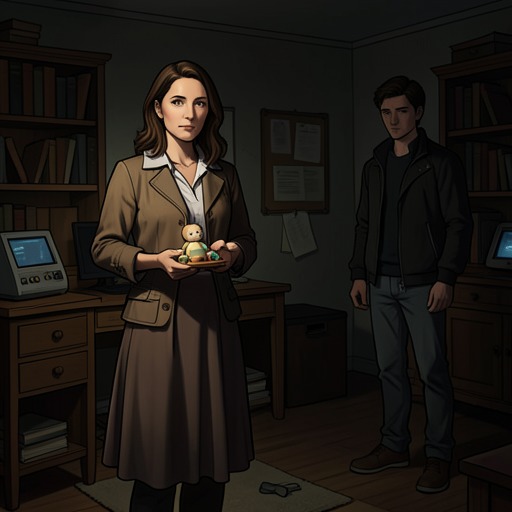
Avery Parker’s search for Calvin
Lessons in ChemistryAvery Parker’s search for Calvin is a belated attempt to repair a separation imposed when she was a teenager, and a chain of missed chances shaped by grief, distrust, and patience. Recounted to Elizabeth Zott, the search reveals that the child long believed dead was Calvin Evans, explains why Avery’s letters reached him without winning a reply, and shows how the institution that had held him obstructed their reunion.
The separation and the discovery
Avery’s account begins with her pregnancy at seventeen. Her prominent parents sent her to a Catholic home for unwed mothers, where young women were expected to relinquish their babies. Avery refused to sign the form surrendering her child. The home’s treatment of her made the refusal costly: she was left without assistance during labor, then, after receiving anesthesia, was told that her baby had been stillborn. When she asked to see the child, she was told the body had already been disposed of. The claim that the baby had died closed off any immediate search; Avery understood herself to have lost her son.
Ten years later, a nurse from the home contacted Avery, now twenty-seven, and sought money in exchange for the truth. The nurse disclosed that the baby had not died but had been adopted. His adoptive parents later died in an accident, and his aunt died as well; after those losses, the child was sent to All Saints Boys Home in Iowa. The information transformed Avery’s understanding of her past: the loss she had accepted was not the death of her child, but the consequence of a concealed adoption and a succession of deaths that had left him in institutional care. She began looking for her son.
An attempt made through an intermediary
Avery did not travel to All Saints Boys Home herself. She later admits to Elizabeth Zott that she was not brave enough to go, and explains that she had already spent years believing her child was dead. Learning that he might be alive revived hope but also exposed her to the possibility of another deception. Like Calvin, she had been targeted by people pretending to be relatives, so she feared acting on a claim that might prove false. Instead, she sent Avery Parker’s lawyer Wilson to the home the day after learning where Calvin was.
That decision was both an effort to reach Calvin and a protective distance from the possibility of disappointment. Avery had a representative verify the lead, but she remained dependent on what the institution told him. The Bishop of All Saints reported that Calvin was dead. The assurance halted the search at the point when Avery had finally located him. Elizabeth understands the home’s financial interest in maintaining the claim: the institution needed money and had a memorial fund. The account thus places the failed search within an imbalance of power: Avery sought information about her child, while the bishop controlled the information available to her and could present a false death as fact.
Recognition through Calvin’s public work
Years later, Avery learned that Calvin was alive through the Chemistry Today Issue Featuring Calvin on the Cover. Avery Parker’s lawyer Wilson brought the issue to her office, and Avery immediately called the bishop. He dismissed the shared surname as coincidence, but Avery recognized that he was lying and intended to sue. Avery Parker’s lawyer Wilson persuaded her that publicity would damage the foundation and embarrass Calvin. Rather than pursue the matter publicly, Avery cut off funding to the home.
The magazine supplied the identification that the home had denied her. It also turned Calvin’s scientific career into a route by which a mother who had never met her son could follow his life. Avery wrote to him several times, explained what she knew as best she could, asked to meet, and offered to fund his research. She received no reply. The letters later acquire their meaning for Elizabeth Zott: she recognizes Avery Parker as the writer who signed the messages Calvin had kept as those from a sad mother. What had seemed like correspondence from an unknown person was Avery’s sustained, unanswered attempt to make contact.
Patience and the missed meeting
Avery considered going to California and arranging a meeting, but chose not to press Calvin. In her view, searching for a child with urgency was different from approaching an adult son, who needed time to assess the possibility that she was his mother. She expected him to investigate the foundation and decide for himself whether her claim was credible. She believed the process might take years and deliberately waited. Looking back, she recognizes that she waited too long.
That restraint follows from the history of the search: Avery had once been told to grieve a child who was alive, then had been given false information when she tried to find him. Caution had protected her from acting on another possible scam, but it also meant that her letters and offer of support were the only approaches she made after discovering his career. Avery had followed Calvin’s progress and thought she might help him, but concludes that it was Elizabeth Zott who needed her help. The search therefore ends not in a reunion but in an explanation delivered too late to create the meeting Avery had hoped for. Its unresolved outcome makes the letters, the false report, and the years of waiting parts of the same loss: Avery found the truth about Calvin, yet never received his answer.